I made a new Twitter account (@CardonaTweets) where I have followed 5 journalists/organizations from fields I am passionate about. The accounts I follow are…
@stephenasmith.
@nytimes
@wojespn
@cnet
@time
I chose to follow Stephen A Smith because of his basketball insight, I like watching him on First Take on ESPN. He tweets snippets from his podcasts, clips from shows, and gives his sports takes as well. He engages with followers through these takes and at times will have a back and forth with others on Twitter.
Adrian Wojnarowski (@wojespn) is another account I follow because of my interest in the NBA. Many of his tweets are links to his articles from ESPN, as well as breaking news regarding trades, deals, and other happenings in the league. By following Woj and Stephen A., I am learning exactly what multimedia journalism looks like. These reporters write articles, record podcasts, and do live appearances on television as well.
The New York Times (@nytimes) covers all kinds of news from tragedies to global pandemics to sports related issues. I chose to follow this organization to keep a general reminder of what is going and to stay up to date on pressing newsworthy topics as well. The Times interact with their followers by liking certain tweets of on site pictures. Notably, there are a few pictures from Wuhan concerning the coronavirus that are liked.
Time (@time) also covers global current events and reports on a wide variety of interesting topics such as AI, the 2020 Olympics, and trends such as TikTok. I like that they do not stick to one lane of news reporting (i.e. politics, trade, etc.). Time does not really interact with followers, being that they hold a massive reputation.
Lastly, CNET (@cnet) is an organization that covers what is happening in technology. These articles interest me because of the many roles technology plays. From big advancements in the medical industry to the announcement of the new PlayStation 5, tech is extremely important in everyday life. This is a personal interest follow because I like to keep up on news about the next iPhone models and next gen consoles.
This is the first post on my new blog. I’m just getting this new blog going, so stay tuned for more. Subscribe below to get notified when I post new updates.
Morristown, New Jersey is a town renowned for its historical significance and diverse community. Many businesses have flourished in Morristown over the years and as a result, the town continues to grow every year. However, this growth has led to redevelopment plans being made for vital sections of the town. Some residents fear this change will do more harm than good to the home they once knew.
This is not the first time residents of the town have faced large scale redevelopments. Long time Morristown residents likened the new development plans to the Headquarters Plaza buildings that were introduced in the 1980’s.
During a town hall meeting in August 2019, an elderly female resident from the 2nd ward said “These buildings block off the 2nd ward from the rest of the town.”
The 2nd ward features a prominent African American and Latino community, both of whom witnessed local businesses struggle after the launch of Headquarters Plaza. Unfortunately, these businesses were lost in vain as the Headquarters Plaza is now known as a commercial dead zone in the town. Many businesses have come and gone as the fortress-like design of the buildings do little to promote on foot traffic in the area.
Despite the failure of Headquarters Plaza in the 1980s, Morristown still managed to bounce back and find commercial success. As NJ Monthly writes, “In recent years, Morristown has turned its long downtown thoroughfare… from a scattering of small shops and minor eateries into one of the most vibrant Restaurant Rows in northern New Jersey.”
Many different restaurants and bars have been introduced and have performed very well over the past decade in Morristown. The town has become a hub for people in northern New Jersey to go eat, drink, and spend their afternoons.
For years now the nightlife scene has been at capacity in Morristown. No more liquor licenses are being distributed as bars like Iron Bar, Grasshopper off the Green, Revolution, and numerous others have left the market “over-saturated”, according to sources from Morristown Green, a local news site.
Business owners love coming to Morristown, it provides profits, plenty of competition, and a great location for publicity. For residents, having so many restaurants has provided more options for lower income families to feed their children.
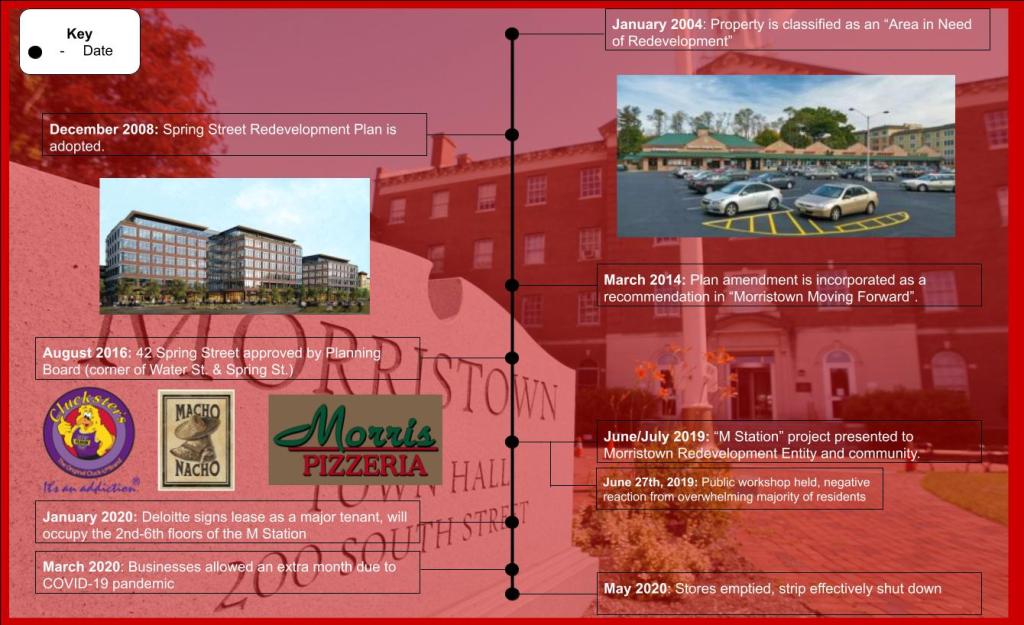
A popular area in the community is the Morris St. strip mall, which consists of several affordable food locations including Burger King, Cluck U Chicken, Macho Nacho, Tops China, and Morris Pizzeria, among others.
These locations are favored for their affordable pricing compared to the upscale restaurants that are situated downtown. In addition to affordable costs, this strip is a mere 10 minute walk away from the black and minority-rich areas of Morristown. For decades, this strip has served as a key source for those communities, but that security is being endangered.
The “M Station” is a proposed multiple use, multiple story building that would replace the strip mall on Morris St.. The space is praised for its potential to bring in more new business and income to Morristown.
Much like the reaction to the Headquarters Plaza back in the 70’s, residents are afraid that the building will further separate its communities. Food locations that are currently relied on will be removed, and residents will have to make tough decisions as their ways of life are challenged.
The Morris St. renovation is not the only proposed project. In many pockets of Morristown, Hoboken-style townhouses have been erected. In almost every case, these townhouses replaced affordable apartment homes that housed black and minority families.
These buildings are modern and come with various features, however as a result, these have further raised the property value in Morristown, which has been on the rise since the turn of the century.
Natalia Andrea, a lifelong Morristown resident, said “I never realized how much it cost to live here until I got older, the more expensive it got the more the culture seemed to go away”.
Andrea, whose parents both came to the United States in the early 90’s, is one of many latino residents who have seen their communities effectively pushed out of Morristown as property values rose.
Many argue that the development of Morristown is nothing more than gentrification fueled by greed.
Andrea notes that the hispanic population has decreased significantly since the 2000’s. Many latino families have moved to the nearby town of Dover to avoid rising property costs.
For a town hailed for its diversity, communities fear that this diversity will suffer as a result of all the incoming buildings, such as the M Station.
Another result of the proposed M Station is a traffic roundabout, set to be constructed at the intersection of the Morris and Spring Streets. This intersection is meant to alleviate traffic concerns, one of the biggest complaints town residents have had over the years as more and more commercial buildings were constructed.
Since 2010, little has been done in terms of the traffic situation in Morristown, which has notably worsened since the turn of the decade. The town sits next to 287, a popular highway for commuters on their way to work in the city. The Morristown train station also brings plenty of commuters to and from the city.
There is a sense of fear that the roundabout will do little to help the traffic situation, and may prove to be more hazardous than helpful among drivers. At the town hall meeting in August 2019, residents cited concerns that drivers would need time to get adjusted, and accidents would occur. The development group cited roundabouts that were added in other towns in New Jersey, such as Jersey City, as evidence that these work. Residents remained unconvinced over the matter.
In an effort to decompress from the nonstop coverage of COVID-19, I decided to look at a multimedia piece that I would personally enjoy. One of my favorite hobbies, past times, and overall passions in life is basketball. I picked it up in high school and it has since grown into a full blown love for the game and the history behind it. Being born in 1997, I was not alive to witness Michael Jordan’s historic run throughout the 1990’s with his Chicago Bulls. Thankfully, in a few days there is a documentary series coming out on ESPN titled “The Last Dance” that takes an up close and personal look at the year Jordan led the Bulls to win his 6th and final championship.
Leading up to the release, ESPN has released several promotional articles, videos, and all kinds of post across their social media channels regarding the documentary and Michael Jordan himself. The multimedia package I decided to look at was titled “Why Michael Jordan’s scoring prowess still can’t be touched”. This package is effective because it is accompanied by so many different forms of media. It includes graphics that detail Jordan’s shots on the floor, videos that show how he scored along with animated bar graphs, and most importantly the article itself, which details how Jordan’s game evolved.
There are charts ranging from an old 90’s graphic that NBC pioneered, showing Jordan’s makes and misses from a playoff game against the Washington Bullets. This graphic is accompanied by a modern shot chart that showcases Jordan’s career field goal percentage from certain areas of the floor. These charts help paint a clearer picture of where Jordan was most efficient and the frequency of different types of shots. The use of analytics, which has taken a firm place in today’s game, is also used to further strengthen the data shown by the old graphic from NBC.
The video is easy to understand. It shows Jordan putting on dominating performances and scoring over defenders with ease. By watching, it becomes easy to understand how good he was and how much he was able to score. The highlights serve as a simple ‘eye test’ that shows his impressive ability. There are also animated bar graphs that show how Jordan was able to make more shots at a higher percentage than the rest of his NBA peers.
The article helps because it uses a variety of sources to back up his nostalgic dominance. Data and number crunching were not popular back in the 90’s, and have only become prominent over the past decade. However, this article applies some of these analytics to accurately compare Jordan to his peers at the time. Also, there are quotes from people who worked closely with Jordan, including Chicago Bulls head coach Phil Jackson. He says “The weakest part of Michael’s game on the offensive end was his shooting, so he obviously mastered something that everybody said he couldn’t do when he came out of college. And he did it by shooting, shooting, shooting, shooting consistently” (ESPN).
Overall, the multimedia components were able to grab, and more importantly maintain, my attention because they were easy to understand and they were visually appealing to look at. The shot charts and the field goal percentage bar graphs looked clean and effectively showcased the data. The videos were remastered, and contained several clips rather than one long dragged out footage. The article used paragraphs instead of blocks, and highlighted key points. All of these factors helped make this piece as effective and entertaining as it was.
I watched a video uploaded to YouTube by ABC News. The segment looks into wet markets in China, where many believe to be the origin of the COVID-19 virus. It is believed that the exposure of meat in conjunction with poor regulations, led to people in Wuhan coming into contact with the virus. These markets are similar to farmers markets that can be found almost anywhere in the United States. The concept is familiar, with merchants displaying produce, non perishable items, and even meat out in the open as buyers are able to walk through and select the items they need.
I was interested in this piece because I have seen many open public markets like this in many places. Here in my home town of Morristown, there are farmers markets that take place every weekend in the town center. It is primarily focused on fruits, produce, and local goods. There are no butcher-style hanging meat hooks, which decreases the risk for spread of disease. These local markets are favored for their beneficial impact on local economy, and are hardly ever considered areas of high risk for spreading disease.
One thing that made me curious, was how exactly news outlets have narrowed down that this disease originated from these markets. How is it that “some guy eating a bat” has become the favored reasoning for the origin of COVID-19? The public has yet to see what exactly the process was that deduced this was the origin. These markets have been favored and in use for decades, so why is it that they now are the cause of a deadly disease? Call me a conspiracist, but life is full of surprises.
Part of me believes there is a fine line between getting to the bottom of the disease, and spreading anti Chinese propaganda. Obviously, China is going to be heavily scrutinized and suffer tremendously when it comes to international relations. Their silence and misleading on the exact death tolls and severity of the disease will be remembered for a long time, and they will have to face consequences. However, people must not allow this to breed ideas of hate and bigotry. We will be no more than a large hate group at that point. Rather, we must look critically at what happened, and avoid making culturally or racially charged judgements about another nation of people.
I would say this piece was unsatisfying. I felt like I had more questions after viewing it. It made me concerned that ignorant people may consume media like this and embolden a hateful mindset when it comes to China and other Asian countries as a result. These sentiments do nothing but separate humanity, at a time when we need to come together.
For my audio package, I decided to look for pieces about “college”. There are so many aspects to discuss when it comes to higher education, I was interested to see what may turn up. Currently, we are experiencing one of the most trying times in recent memory with the outbreak of COVID-19. This pandemic has turned the college experience on its head. No longer are students and professors on campus or meeting for classes in person. Rather, we have adapted to an online method of learning that involves video call class sessions, online assignments, and syllabi being rewritten at the halfway point of the semester.
This audio piece dates back to 2016, and it specifically tackles the notion that getting into a recognized university will determine whether the student finds success. Prestige of university vs what the student does with their time in college ultimately becomes the debate of this piece. This interested me because I felt this somewhat during my college application process. I applied to schools I had never heard of before, as well as more recognized universities such as Rutgers.
One aspect that frustrated me was the notion that being admitted to a recognized university meant success, rather than what the student is able to accomplish with his or her time there. I have seen many examples of this with my classmates. There are several students who have accepted jobs with big name companies, hospitals, and other professional fields coming out of Fairleigh Dickinson University. Although FDU is a recognized university in New Jersey and the tri state area, I have personally met students from West Virginia University, Boston College, and other schools around the country who were unfamiliar with FDU. This further strengthens the argument that it is not about the status of the university, but rather what the student does with their time while in college that ultimately determines their future.
Overall, I felt this piece was ultimately satisfying. It reassured what I had already believed about college and determining one’s future. I did not know what to expect 4 years ago when I was an incoming freshman. I knew at the end of this journey, I wanted to have my job figured. Not only are my options open after I graduate, but I am also in a position to support a business I founded with my friends 3 years ago.
I looked at a photo package produced by the New York Times titled “College Life”. The slideshow takes several images, mainly taken around 2010, that depict college life and the transition from adolescence to adulthood that happens when teens go away to college. I found this piece interesting and very enjoyable because I could relate to so many of the images. Many of them were unique, and showed parts of the college experience that I had gone through myself.
My college experience was different in that I did not live in a dorm or on campus at all. Rather, I commuted throughout all 4 years of my undergraduate degree. There were several aspects I missed out on, from becoming independent and learning to fully provide for myself, to the social opportunities that living on campus provides students. However, I feel grateful for being able to stay close to my family and undertake several different jobs while still living at home.
The second picture of the slideshow shows several college students crowded in a bathtub. Clearly, this photo was taken in the middle of a fun night for the group. This picture made me remember fun nights where my friends and I had similar dumb moments.
Another picture in the slideshow showed two female college students kissing during a protest in California. This picture was from November 2008, a time when gay marriage was still illegal. This image interested me because it showed how people discover who they are and the things they value while in college. This is a transitional time where many people discover their sexualities, their identities, and other critical aspects that make us individuals. I have met FDU students who have become more comfortable with their sexualities and other aspects of their identities while in college away from home.
My favorite image from this piece was titled “I Couldn’t Say It To His Face”. It is a simple image of someones torso in a grey t shirt. The caption of the picture made it stand out to me. It reads “My relationship with my brother and mother took a dramatic turn when I went to college, and at first I didn’t understand what was happening. I realized that as an adult, I am the equal of these people. It wasn’t that our relationships were deteriorating. We were becoming friends.” I love this quote, because I have slowly experienced this during my college years. I can identify with the feeling that I am becoming the equal of my parents, rather than just the dependent child that has lived under them for my whole life. This has been harder for my mother, but my dad has for a long time been far more understanding and able to empathize with my situation
This piece was very satisfying. It comes at a fitting time where I am about to graduate and begin to look back at my college experience rather than living in it.
This is an example post, originally published as part of Blogging University. Enroll in one of our ten programs, and start your blog right.
You’re going to publish a post today. Don’t worry about how your blog looks. Don’t worry if you haven’t given it a name yet, or you’re feeling overwhelmed. Just click the “New Post” button, and tell us why you’re here.
Why do this?
Because it gives new readers context. What are you about? Why should they read your blog?
Because it will help you focus you own ideas about your blog and what you’d like to do with it.
The post can be short or long, a personal intro to your life or a bloggy mission statement, a manifesto for the future or a simple outline of your the types of things you hope to publish.
To help you get started, here are a few questions:
Why are you blogging publicly, rather than keeping a personal journal?
What topics do you think you’ll write about?
Who would you love to connect with via your blog?
If you blog successfully throughout the next year, what would you hope to have accomplished?
You’re not locked into any of this; one of the wonderful things about blogs is how they constantly evolve as we learn, grow, and interact with one another — but it’s good to know where and why you started, and articulating your goals may just give you a few other post ideas.
Can’t think how to get started? Just write the first thing that pops into your head. Anne Lamott, author of a book on writing we love, says that you need to give yourself permission to write a “crappy first draft”. Anne makes a great point — just start writing, and worry about editing it later.
When you’re ready to publish, give your post three to five tags that describe your blog’s focus — writing, photography, fiction, parenting, food, cars, movies, sports, whatever. These tags will help others who care about your topics find you in the Reader. Make sure one of the tags is “zerotohero,” so other new bloggers can find you, too.