Gentrification of Morristown
Morristown, New Jersey is a town renowned for its historical significance and diverse community. Many businesses have flourished in Morristown over the years and as a result, the town continues to grow every year. However, this growth has led to redevelopment plans being made for vital sections of the town. Some residents fear this change will do more harm than good to the home they once knew.
This is not the first time residents of the town have faced large scale redevelopments. Long time Morristown residents likened the new development plans to the Headquarters Plaza buildings that were introduced in the 1980’s.
During a town hall meeting in August 2019, an elderly female resident from the 2nd ward said “These buildings block off the 2nd ward from the rest of the town.”
The 2nd ward features a prominent African American and Latino community, both of whom witnessed local businesses struggle after the launch of Headquarters Plaza. Unfortunately, these businesses were lost in vain as the Headquarters Plaza is now known as a commercial dead zone in the town. Many businesses have come and gone as the fortress-like design of the buildings do little to promote on foot traffic in the area.
Despite the failure of Headquarters Plaza in the 1980s, Morristown still managed to bounce back and find commercial success. As NJ Monthly writes, “In recent years, Morristown has turned its long downtown thoroughfare… from a scattering of small shops and minor eateries into one of the most vibrant Restaurant Rows in northern New Jersey.”
Many different restaurants and bars have been introduced and have performed very well over the past decade in Morristown. The town has become a hub for people in northern New Jersey to go eat, drink, and spend their afternoons.
For years now the nightlife scene has been at capacity in Morristown. No more liquor licenses are being distributed as bars like Iron Bar, Grasshopper off the Green, Revolution, and numerous others have left the market “over-saturated”, according to sources from Morristown Green, a local news site.
Business owners love coming to Morristown, it provides profits, plenty of competition, and a great location for publicity. For residents, having so many restaurants has provided more options for lower income families to feed their children.
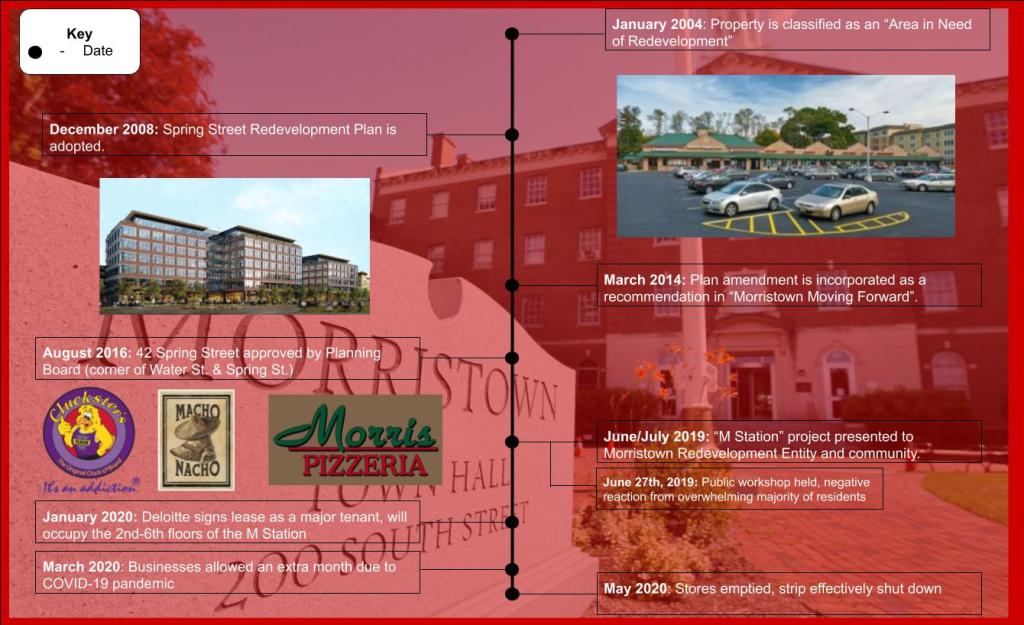
A popular area in the community is the Morris St. strip mall, which consists of several affordable food locations including Burger King, Cluck U Chicken, Macho Nacho, Tops China, and Morris Pizzeria, among others.
These locations are favored for their affordable pricing compared to the upscale restaurants that are situated downtown. In addition to affordable costs, this strip is a mere 10 minute walk away from the black and minority-rich areas of Morristown. For decades, this strip has served as a key source for those communities, but that security is being endangered.
The “M Station” is a proposed multiple use, multiple story building that would replace the strip mall on Morris St.. The space is praised for its potential to bring in more new business and income to Morristown.
Much like the reaction to the Headquarters Plaza back in the 70’s, residents are afraid that the building will further separate its communities. Food locations that are currently relied on will be removed, and residents will have to make tough decisions as their ways of life are challenged.
The Morris St. renovation is not the only proposed project. In many pockets of Morristown, Hoboken-style townhouses have been erected. In almost every case, these townhouses replaced affordable apartment homes that housed black and minority families.
These buildings are modern and come with various features, however as a result, these have further raised the property value in Morristown, which has been on the rise since the turn of the century.
Natalia Andrea, a lifelong Morristown resident, said “I never realized how much it cost to live here until I got older, the more expensive it got the more the culture seemed to go away”.
Andrea, whose parents both came to the United States in the early 90’s, is one of many latino residents who have seen their communities effectively pushed out of Morristown as property values rose.
Many argue that the development of Morristown is nothing more than gentrification fueled by greed.
Andrea notes that the hispanic population has decreased significantly since the 2000’s. Many latino families have moved to the nearby town of Dover to avoid rising property costs.
For a town hailed for its diversity, communities fear that this diversity will suffer as a result of all the incoming buildings, such as the M Station.
Another result of the proposed M Station is a traffic roundabout, set to be constructed at the intersection of the Morris and Spring Streets. This intersection is meant to alleviate traffic concerns, one of the biggest complaints town residents have had over the years as more and more commercial buildings were constructed.
Since 2010, little has been done in terms of the traffic situation in Morristown, which has notably worsened since the turn of the decade. The town sits next to 287, a popular highway for commuters on their way to work in the city. The Morristown train station also brings plenty of commuters to and from the city.
There is a sense of fear that the roundabout will do little to help the traffic situation, and may prove to be more hazardous than helpful among drivers. At the town hall meeting in August 2019, residents cited concerns that drivers would need time to get adjusted, and accidents would occur. The development group cited roundabouts that were added in other towns in New Jersey, such as Jersey City, as evidence that these work. Residents remained unconvinced over the matter.
 Cardona's Corner